
— OPEN HOUSE · AGES 3–12 · VEYRIER CAMPUS
Your child is learning.
But is he or she learning to think?
Come see, in the classroom, how the fundamentals become a way of thinking. It’s not about learning less. It’s about learning more deeply.
— FREE REGISTRATION
Sign up for the tour.
Free. We confirm each registration by email.
— WHAT YOU'RE ABOUT TO EXPERIENCE
Two hours to see how we learn here.
Visit the classrooms
The places where your child will actually learn on a typical school day.
Meet the Teachers
The people who will be supporting your child on a daily basis are here to answer your questions.
Let yourself be inspired
The teachers have prepared a few questions for you so that we can reflect together on how your child learns.
— THE CHALLENGE · TRY IT ALONE OR WITH YOUR FAMILY
What about you? how would you have figured it out?
A elementary school math problem. The correct answer matters. Your thought process matters even more.
In the yard, some children are walking their dogs. There are 10 heads and 28 legs. How many children are there?
What did you think?
Answer the question, choose your approach, and then check your work. Next, compare your answer with three other ways to find the solution.
Six kids and four dogs. Way to go. Now, the real question: How do you know for sure?
Not yet. And that's fine: here, a mistake is a starting point. Hint: what if everyone raised two paws?
No answer? Try it anyway. Here, a mistake is a starting point.
"How did you figure that out? Why did you use that method? Could you try a different approach? How can you verify your result?"
With just a few questions, a math problem becomes an opportunity to develop reasoning and creativity. You have just engaged:
— OUR APPROACH
Five Skills for Learning Today and think about tomorrow.
These aren't just five additional subjects. They come to life through everyday learning.
Ask Questions and Present Arguments
To imagine rather than merely reproduce
Understanding How We Learn
Keep trying instead of giving up
Choose, rather than simply follow
Friday, the 27th, in the evening: the parents' night out
We'll watch your kids ages 6 to 12 from 5 p.m. to 10 p.m. You have homework to do.
Do you also have a child between the ages of 3 and 6?
Open House at our two campuses:
November 18 in Frank-Thomas
November 27 in Veyrier
— IN PICTURES
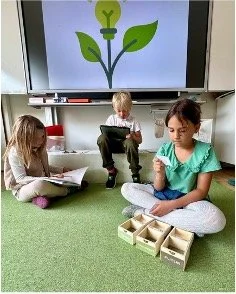
Life at theEcole Eden, day to day.